



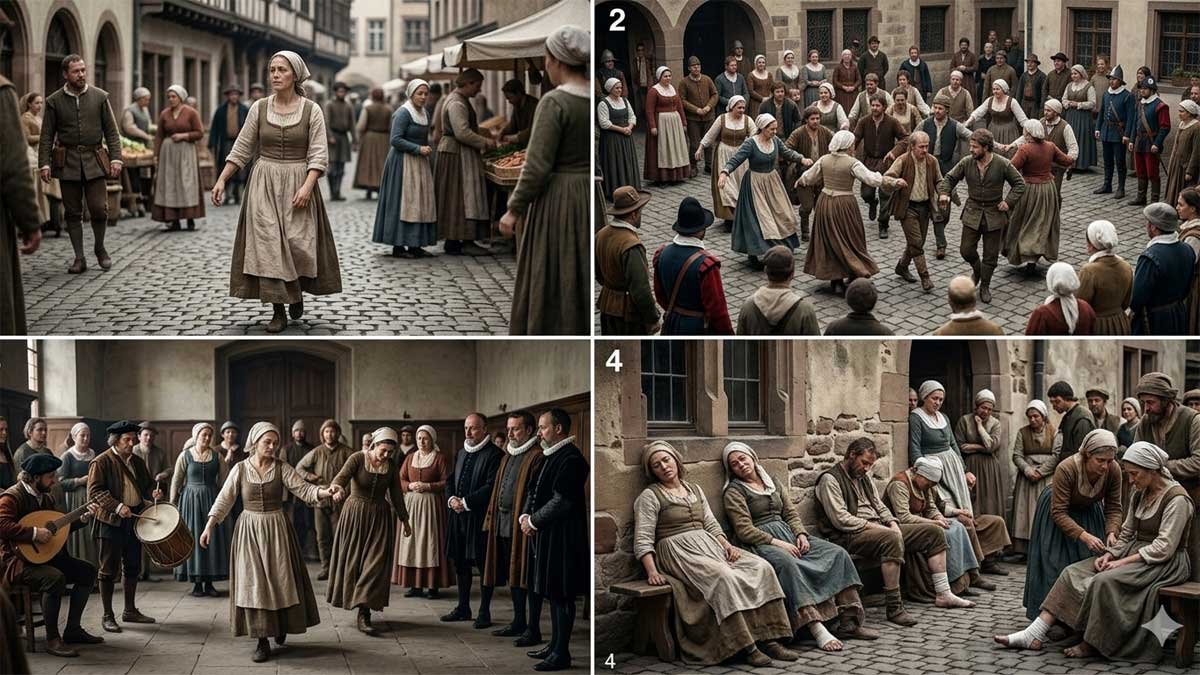
Imagine walking through a crowded European city and suddenly seeing a woman dancing in the street.
Thank you for reading this post, don't forget to subscribe!She doesn’t stop.
People watch her.
Hours pass.
She keeps dancing.
Then something even stranger happens.
Other people begin dancing too.
Within days, the streets of Strasbourg are filled with people caught in a bizarre dancing episode that nobody seems able to explain.
This isn’t the opening of a horror movie.
It is based on a real historical event from 1518, remembered today as the Dancing Plague of 1518.
And more than 500 years later, one question remains:
Why did they dance?
It Started With One Woman
In the summer of 1518, Strasbourg was a city living through difficult times.
People were dealing with poverty, disease, hunger and intense social and religious pressures.
Then something extraordinary happened.
According to historical accounts, a woman commonly identified as Frau Troffea began dancing in the street.
There was apparently no music playing for her.
Nobody had asked her to dance.
Yet she continued.
At first, people probably thought it was simply strange behavior.
But the situation didn’t end after a few minutes.
The dancing continued.
And then other people became involved.
The Mystery Spread
Within days, more people reportedly began dancing.
What had started with one person appeared to become a much larger phenomenon.
Historical accounts suggest that the number of affected people eventually reached hundreds, although the exact number remains uncertain.
Imagine the scene.
A crowded medieval city.
People watching from windows.
People gathering in the streets.
And in the middle of it all, groups of people apparently dancing without being able to stop normally.
There was confusion.
There was fear.
And nobody knew what was happening.
The Authorities Didn’t Know What To Do
Today, if hundreds of people suddenly developed strange symptoms, doctors and emergency services would investigate possible medical, neurological or psychological causes.
But Strasbourg in 1518 had none of today’s medical knowledge.
People searched for explanations using the ideas available to them at the time.
Some believed the phenomenon could have a supernatural or religious connection.
Others looked for physical causes.
Eventually, local authorities decided that perhaps the dancers needed to dance their problem away.
And this decision made the strange situation even more remarkable.
They Actually Brought in Musicians
According to historical accounts, authorities supported measures that included providing spaces where the affected people could continue dancing.
Musicians were brought in.
A special place was reportedly prepared.
The reasoning seems almost unbelievable today:
If people needed to dance, perhaps allowing them to dance would eventually cure the problem.
Instead, the dancing reportedly continued.
More people became involved.
The situation became increasingly difficult to understand.
Some People Became Exhausted
The dancing was not simply a harmless party.
Historical descriptions report that some people became extremely exhausted and suffered physical consequences.
Some accounts even mention deaths.
However, historians debate important details of the event, including the exact number of people affected and how many, if any, actually died because of the dancing.
That’s why the safest way to describe the event is not as a confirmed mass-death incident, but as a mysterious historical episode surrounded by uncertain contemporary reports.
But Why Were They Dancing?
This is where the story becomes truly fascinating.
More than five centuries later, there is no universally accepted explanation.
Researchers and historians have proposed several theories.
1. Mass Psychogenic Illness
One of the leading modern explanations is a phenomenon sometimes described as mass psychogenic illness.
The idea is that extreme stress, fear and social pressure can sometimes produce unusual physical or behavioral symptoms across groups of people.
Strasbourg was experiencing difficult conditions at the time.
That could have created an environment where fear and psychological stress spread rapidly.
2. Poisoned Food?
Another theory suggests that people may have consumed grain contaminated with ergot, a fungus that can produce hallucinations and other symptoms.
This idea sounds like something from a horror movie.
But historians have pointed out problems with using ergot poisoning as the complete explanation.
So while it remains part of the discussion, it hasn’t solved the mystery.
3. Religious Beliefs
People in 1518 understood illness very differently from people today.
Some believed supernatural forces could cause suffering.
The strange dancing was reportedly associated with Saint Vitus, a figure connected in European tradition with dancing-related afflictions.
Fear and religious belief may therefore have played an important role in how people interpreted what was happening.
Did They Really Dance for Two Months?
This is one of the most misunderstood parts of the story.
The overall episode is generally described as lasting weeks, roughly from July into September 1518.
But that does not mean every person danced continuously for two months without sleeping or stopping.
Historical records are incomplete, and the exact duration of individual episodes isn’t known with certainty.
Some accounts describe people dancing for days, but we should be careful about treating every dramatic detail as proven fact.
What Happened to Frau Troffea?
Interestingly, the fate of the woman who supposedly started the episode is not clearly documented.
She is remembered as Frau Troffea in historical accounts, but we don’t have a reliable record telling us exactly what happened to her afterward.
There is no solid evidence that she died because of the dancing.
And that’s another reason the story should be treated as a historical mystery, rather than a confirmed supernatural horror story.
Then, Somehow, It Stopped
Perhaps the strangest part is what happened next.
The dancing phenomenon eventually faded away.
The city moved on.
The people who had witnessed the strange events returned to their ordinary lives.
But nobody could give the people of Strasbourg a simple answer:
What had caused hundreds of people to dance?
Was it illness?
Psychological stress?
Contaminated food?
Religious fear?
Or something we still don’t completely understand?
A Mystery That Survived 500 Years
More than five centuries later, the Dancing Plague of 1518 continues to attract historians, researchers and curious readers.
The event is fascinating because it sits somewhere between history, medicine, psychology and mystery.
There is no confirmed evidence that a supernatural force made the people dance.
At the same time, the surviving records aren’t detailed enough to answer every question.
And that’s what makes the story so compelling.
We know something extraordinary happened.
But we don’t know exactly why.
Imagine Being There
Imagine standing in Strasbourg in 1518.
You see one person dancing.
Then another.
Then another.
You ask someone what’s happening.
Nobody knows.
The doctors don’t know.
The authorities don’t know.
The people don’t know.
And then someone tells you:
“They can’t stop.”
You look toward the street.
More people are dancing.
The music is playing.
The crowd is growing.
And somewhere in the middle of all that confusion, a question begins spreading through the city:
What is happening to us?
More than 500 years later, we are still asking essentially the same question.
The Real Horror of the Dancing Plague
Perhaps the most frightening thing about the Dancing Plague isn’t that something supernatural happened.
It’s that ordinary people experienced something extraordinary without understanding it.
They didn’t have modern medicine.
They didn’t have modern psychology.
They didn’t have the scientific tools we have today.
They simply had a mysterious event happening around them—and very few ways to explain it.
That’s what makes the Dancing Plague of 1518 one of history’s strangest mysteries.
Final Thought
The Dancing Plague of 1518 may never have a single definitive explanation.
It could have involved psychological stress, social influence, illness, environmental factors or a combination of several things.
What we do know is that Strasbourg experienced a bizarre dancing episode in 1518 that became one of the most unusual events recorded in European history.
And perhaps the biggest mystery isn’t simply:
“Why were they dancing?”
It’s this:
How can an entire community become part of something nobody understands?
Written by Entertainment Dhamaka