




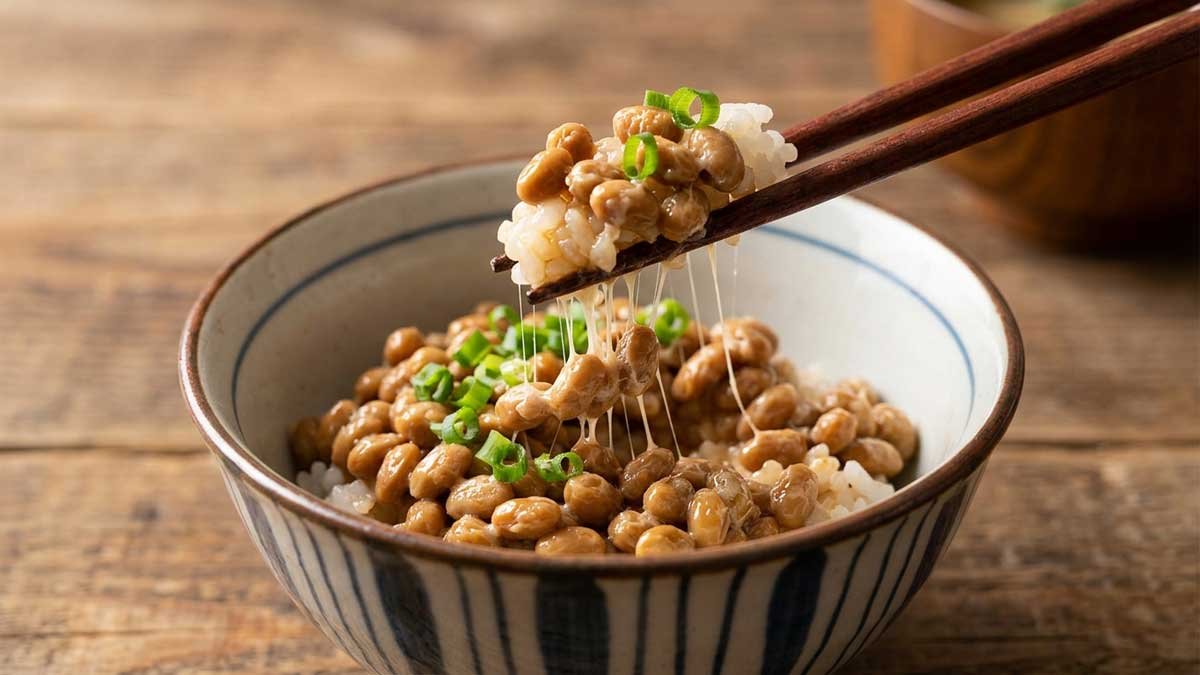
At first glance, natto may not look like something most people would immediately want to eat.
Thank you for reading this post, don't forget to subscribe!It is sticky. It has a strong smell. And when you stir it, long, stretchy strings appear between the beans.
Yet in Japan, natto has been enjoyed for generations and remains a familiar traditional food, particularly as a breakfast dish served with rice. It is made by fermenting cooked soybeans with Bacillus subtilis var. natto.
So, why do people eat something that looks—and smells—so unusual?
The answer is a fascinating combination of Japanese food culture, fermentation, nutrition and tradition.

What Exactly Is Natto?
Natto is a traditional Japanese fermented soybean food.
To make it, cooked soybeans are fermented using a specific bacterium called Bacillus subtilis var. natto. During fermentation, the beans develop their characteristic sticky texture and distinctive aroma.
Unlike many familiar soybean products such as tofu or soy milk, natto keeps the whole soybean intact.
When you stir it, the beans become covered with a sticky substance that produces long, thin strings.
That unusual texture is one of the first things people notice.
For someone trying natto for the first time, the experience can be surprising.
But for regular natto eaters, that sticky texture is part of what makes the food special.
Why Is Natto So Sticky?
The famous strings aren’t simply caused by water or oil.
They are produced during the fermentation process.
The microorganisms involved in natto fermentation create compounds that contribute to its characteristic viscous, stringy texture. This is one of the easiest ways to distinguish natto from ordinary cooked soybeans.
The more you stir natto, the more noticeable those strings can become.
That’s why videos of people preparing natto often look almost unbelievable to people who have never seen it before.
Why Does Natto Smell So Strong?
Natto has a distinctive aroma that some people find pleasant and others find difficult to tolerate.
Fermentation changes the chemical composition of the soybeans and produces various compounds responsible for the food’s characteristic smell.
This is actually common with many fermented foods.
Think about foods such as:
- Kimchi
- Strong cheeses
- Fermented fish
- Miso
- Certain pickled foods
They can all have strong aromas that may seem unusual to someone encountering them for the first time.
Natto is simply one of the more extreme examples.
How Is Natto Traditionally Eaten?
One of the simplest ways to eat natto is with steamed rice.
The natto is usually stirred, and seasonings such as soy sauce and Japanese mustard may be added.
It can then be placed over rice.
Some people also add:
- Green onions
- Raw egg
- Seaweed
- Japanese seasonings
- Other toppings
The exact preparation depends on personal preference.
For many Japanese households, natto isn’t treated as an exotic health food.
It’s simply part of everyday food culture.
Is Natto Actually Healthy?
This is where natto becomes particularly interesting.
Soybeans themselves are nutrient-rich foods, providing protein, fiber, vitamins and minerals.
Fermentation can also change the nutritional characteristics of soybeans.
Natto is particularly well known for its vitamin K content, including vitamin K2 in the form of menaquinone-7 (MK-7). Research has found that consuming natto can substantially increase circulating MK-7 levels.
However, it’s important not to turn natto into a “miracle food.”
Eating natto doesn’t automatically make someone healthy.
Overall diet, physical activity, sleep and other lifestyle factors matter much more than any single food.
What Is Vitamin K2?
Vitamin K is involved in several important processes in the body, including normal blood clotting and bone-related functions.
Natto is particularly notable because it contains substantial amounts of menaquinone-7 (MK-7), a form of vitamin K2.
This is one reason natto has attracted attention from nutrition researchers.
However, people taking vitamin K-sensitive blood-thinning medication such as warfarin should not suddenly add large amounts of natto to their diet without discussing it with their healthcare professional.
What Is Nattokinase?
You may have heard another unusual word associated with natto:
Nattokinase.
Nattokinase is an enzyme associated with natto fermentation and has been studied for possible effects related to cardiovascular and blood-clotting processes.
This has resulted in many dramatic claims online.
But it’s important to separate scientific research from internet marketing.
Research into nattokinase is ongoing, and it should not be considered a replacement for prescribed medication or medical treatment. Evidence for using nattokinase supplements to prevent or treat disease is not strong enough to justify treating it as a miracle cure.
So if you see a headline claiming that natto can “clean your arteries” or “prevent heart attacks,” be cautious.
A traditional food can be nutritious without being a medical treatment.
Why Is Natto Considered a Traditional Japanese Food?
Natto isn’t a new health trend invented by social media.
It has a long history in Japanese food culture.
Fermentation has historically been an important way of preserving and transforming foods, and natto became established as a traditional fermented soybean food.
Today, it remains particularly associated with breakfast.
A typical Japanese breakfast may include rice, miso soup, grilled fish, pickles and other dishes, with natto sometimes included.
This is one reason natto is fascinating from a cultural perspective.
It’s not simply something people eat because it is “healthy.”
For many people, it is also familiar, traditional food.
Why Do Some People Hate Natto?
Taste is personal.
Someone who loves fermented foods might enjoy natto immediately.
Someone else may find the smell and texture difficult.
The combination of:
strong aroma + sticky beans + unusual texture
can be a serious challenge for first-time eaters.
Some people say the flavor is savory and earthy.
Others compare the smell to strong fermented foods.
There is no universally correct reaction.
It’s simply one of those foods that you may need to try before deciding whether you like it.
Is Natto a Superfood?
The word “superfood” is often used for foods that contain notable amounts of certain nutrients.
Natto certainly has an impressive nutritional profile.
It provides:
- Plant-based protein
- Fiber
- Vitamins
- Minerals
- Vitamin K
- Fermentation-derived compounds
But calling it a magical food would be misleading.
A healthy diet isn’t built around one ingredient.
Instead, natto can be considered one nutritious option within a balanced diet.
Why Is Natto Becoming Popular Outside Japan?
The internet has played a major role in introducing unusual foods to global audiences.
Videos showing people opening a package of natto, stirring it and watching the sticky strings stretch have become popular because the food looks so different from what many viewers are accustomed to.
Nutrition enthusiasts have also become interested in fermented foods.
As a result, natto has moved from being a traditional Japanese breakfast item to an internationally discussed food.
People are now trying it in different countries simply because they want to know:
“What does this strange sticky food actually taste like?”
How Should a Beginner Try Natto?
If you’ve never eaten natto before, you don’t have to start with a large serving.
A simple approach is to try a small amount with warm rice.
You can add the seasoning packet that commonly comes with packaged natto or use familiar toppings such as chopped green onions.
Don’t judge it purely by appearance.
Fermented foods often look very different from their unfermented ingredients.
And remember:
The first bite may be unusual.
That’s part of the experience.
Natto vs Tofu: What’s the Difference?
Both foods come from soybeans, but they’re very different.
| Feature | Natto | Tofu |
|---|---|---|
| Main ingredient | Soybeans | Soy milk |
| Process | Fermentation | Coagulation |
| Texture | Sticky and stringy | Soft or firm |
| Flavor | Strong, fermented | Mild |
| Common uses | Rice, breakfast, toppings | Soups, stir-fries, dishes |
| Vitamin K2 | Particularly notable | Generally much lower |
Natto and tofu can both be nutritious, but they aren’t interchangeable in terms of texture, taste or preparation.
The Most Interesting Thing About Natto
Perhaps the most fascinating thing about natto isn’t its nutrition.
It’s the fact that something that looks so strange to outsiders can be completely ordinary to the people who grew up eating it.
That tells us something important about food.
We don’t just eat food because of how it looks.
We eat it because of:
culture, family, tradition, taste and habit.
A food that seems unusual to one person can be comfort food to another.
And natto is a perfect example.
Final Thoughts
Natto may look unusual, smell strong and feel unlike almost anything else you’ve eaten.
But behind its strange appearance is a fascinating combination of Japanese tradition and fermentation.
It provides plant-based protein and is particularly notable for vitamin K2, while research continues into other compounds associated with fermented natto.
It’s not a miracle cure, and it shouldn’t replace medical treatment or a balanced diet.
But as a traditional food, natto is certainly one of the world’s most interesting examples of how fermentation can transform a simple ingredient into something completely different.
So the next time you see a bowl of sticky beans and wonder:
“Who would actually eat that?”
The answer is:
Millions of people—and they’ve been doing it for generations.
Written by Entertainment Dhamaka
This article is for general educational and lifestyle information and is not a substitute for personalized medical advice.