



Imagine a wall of concrete and earth standing hundreds of meters above the ground, holding back billions of cubic meters of water.
Thank you for reading this post, don't forget to subscribe!Some dams are so enormous that they look more like cities than engineering structures. They generate electricity, control floods, provide water for agriculture, and support millions of people.
But which are the biggest?
The answer depends on how we measure “biggest.” A dam can be ranked by its height, reservoir capacity, structural volume, or electricity-generating capacity.
Here are 10 of the world’s largest and most impressive dams, along with the stories behind them.
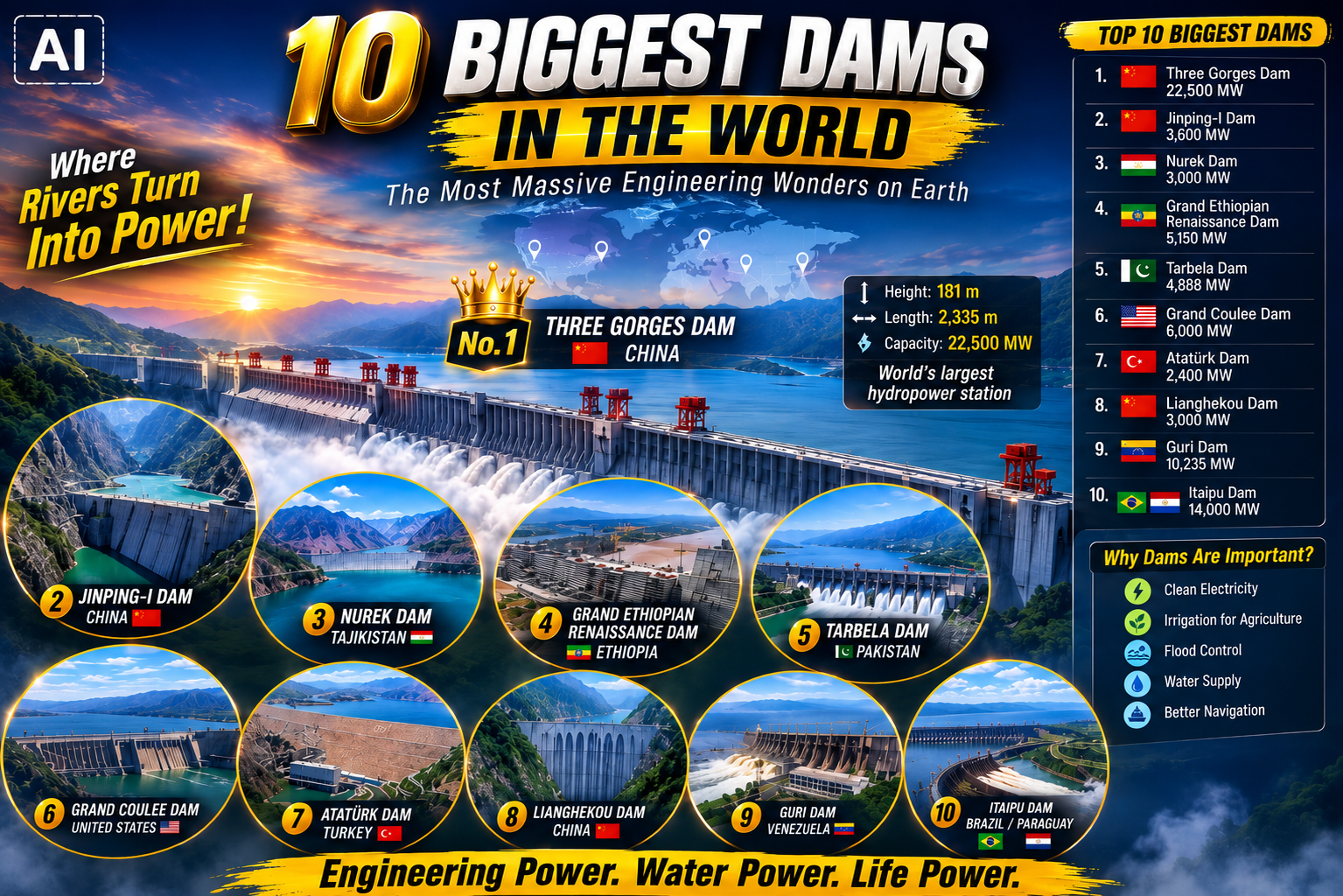
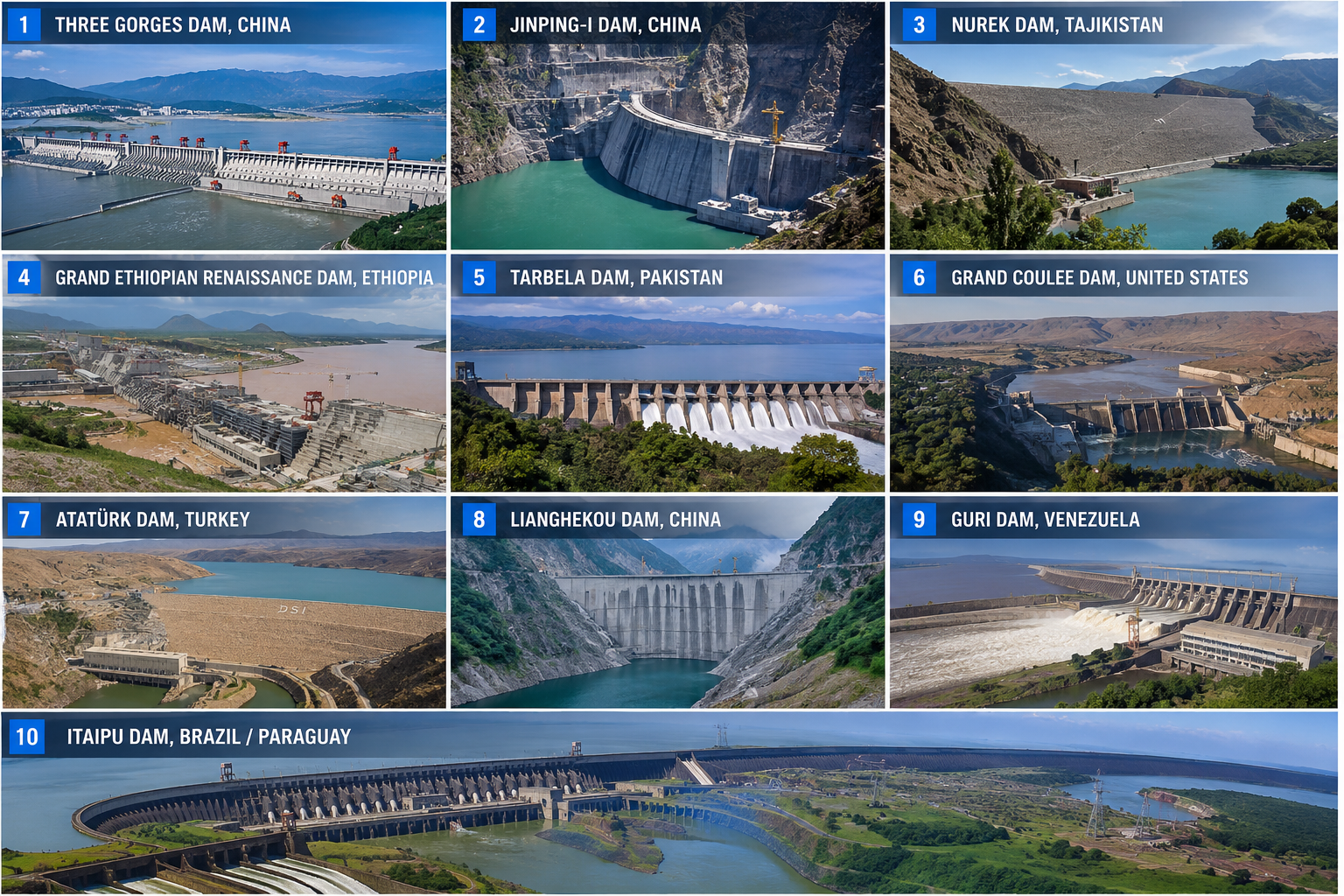
1. Three Gorges Dam — China
When people talk about the world’s most powerful hydroelectric dams, Three Gorges Dam is usually the first name that comes to mind.
Built across the Yangtze River in China, the dam is approximately 181 meters high and around 2,335 meters long.
Its greatest achievement is its enormous electricity-generating capacity.
The Three Gorges hydropower station has an installed capacity of 22,500 MW, making it the world’s largest hydropower station by installed capacity.
But the project was designed for more than electricity.
It also helps with flood control and improves navigation along the Yangtze River.
Standing beside this enormous structure, it is difficult to imagine that an entire river can be controlled by a man-made barrier.
2. Jinping-I Dam — China
Imagine standing at the bottom of a structure more than 300 meters high.
That is the scale of Jinping-I Dam.
Located on the Yalong River in Sichuan, China, Jinping-I has a height of approximately 305 meters.
According to Guinness World Records, it is the world’s highest dam.
The dam was built in a mountainous region where engineers had to work with difficult terrain and enormous water pressure.
Its hydropower station has an installed capacity of approximately 3,600 MW.
For a structure made by humans, its height is almost unbelievable.
3. Nurek Dam — Tajikistan
Deep in the mountains of Tajikistan stands Nurek Dam, one of the world’s tallest dams.
Built on the Vakhsh River, the dam reaches approximately 300 meters in height.
Its enormous reservoir can hold roughly 10.5 billion cubic meters of water.
Nurek has played an important role in Tajikistan’s electricity supply and water management for decades.
For many years, it was considered the world’s tallest dam before newer projects surpassed it.
Surrounded by mountains, Nurek looks almost like a giant wall carved into the landscape.
4. Grand Ethiopian Renaissance Dam — Ethiopia
The Grand Ethiopian Renaissance Dam, commonly known as GERD, is one of Africa’s largest hydroelectric projects.
It stands on the Blue Nile River in Ethiopia.
The dam’s reservoir has a capacity of roughly 74 billion cubic meters, making it an enormous water-storage project.
Its planned generating capacity is around 5,150 MW.
For Ethiopia, the project represents a major investment in electricity generation and economic development.
However, because the dam is located on the Blue Nile, it has also become the center of a long-running regional dispute over water management involving downstream countries.
This makes GERD more than just an engineering project—it is also one of the most important water-related projects in modern Africa.
5. Tarbela Dam — Pakistan
Pakistan’s Tarbela Dam is one of the world’s largest earth-filled dams.
It was constructed on the Indus River and plays an important role in irrigation and electricity generation.
The dam has a structural volume of approximately 153 million cubic meters, placing it among the largest dams in the world by structure volume.
Its reservoir can store billions of cubic meters of water, while its hydropower facilities have an installed capacity of several thousand megawatts.
Tarbela is particularly important for Pakistan’s agricultural economy because the Indus River system provides water to millions of acres of farmland.
6. Grand Coulee Dam — United States
On the Columbia River in Washington State stands Grand Coulee Dam, one of America’s greatest engineering projects.
The dam is approximately 168 meters high and about 1,592 meters long.
Its massive structure stretches across the Columbia River and forms part of the Columbia Basin Project.
Grand Coulee is used for several purposes, including:
- Hydroelectric power generation
- Irrigation
- Water management
Its generating capacity is approximately 6,800 MW.
The scale of the project is enormous, especially when viewed from the river below.
7. Atatürk Dam — Turkey
Turkey’s Atatürk Dam is one of the country’s most important water and energy projects.
It was built across the Euphrates River as part of the Southeastern Anatolia Project.
The dam is approximately 166 meters high, and its reservoir can hold roughly 48.7 billion cubic meters of water.
Its hydroelectric power station has an installed capacity of around 2,400 MW.
Besides generating electricity, the reservoir provides water that supports agriculture in the region.
The project dramatically changed the landscape around the Euphrates.
8. Lianghekou Dam — China
Another remarkable structure in China’s mountainous region is Lianghekou Dam.
Located in the Yalong River system, the dam reaches approximately 295 meters in height.
Its hydropower station has a capacity of around 3,000 MW, while its reservoir can hold billions of cubic meters of water.
Building such a massive structure in a mountainous environment required complex engineering and careful planning.
The surrounding landscape makes the scale of the dam even more impressive.
9. Guri Dam — Venezuela
Venezuela’s Guri Dam, also known as the Simón Bolívar Hydroelectric Plant, is located on the Caroní River.
It is one of the world’s largest hydroelectric facilities.
The dam is approximately 162 meters high, while its enormous reservoir stores a huge volume of water.
Its installed generating capacity is around 10,235 MW.
For decades, Guri has played a major role in Venezuela’s electricity system.
The enormous reservoir also transformed the landscape surrounding the Caroní River.
10. Itaipu Dam — Brazil and Paraguay
Imagine a dam shared by two countries.
That is Itaipu Dam, located on the Paraná River along the border between Brazil and Paraguay.
Itaipu has an installed generating capacity of approximately 14,000 MW, making it one of the world’s most powerful hydroelectric facilities.
The project is particularly remarkable because Brazil and Paraguay jointly operate it.
For many years, Itaipu broke records for annual electricity generation.
Its enormous turbines transform the power of the Paraná River into electricity used by millions of people.
Which Is the Biggest Dam in the World?
There is no single answer because “biggest” depends on the measurement.
Biggest by Hydroelectric Capacity
Three Gorges Dam leads with an installed capacity of approximately 22,500 MW.
Highest Dam
Jinping-I Dam reaches approximately 305 meters, making it the world’s highest dam.
Largest by Structural Volume
Tarbela Dam is among the world’s largest dams by structural volume, with approximately 153 million cubic meters of material.
So, when someone asks, “What is the world’s biggest dam?” the correct answer depends on what exactly they mean by biggest.
Why Are These Dams So Important?
Dams are not simply giant walls holding back water.
They can provide several essential services.
Electricity:
Hydropower stations convert the energy of moving water into electricity.
Irrigation:
Stored water can be released to agricultural areas during dry periods.
Flood Control:
Large reservoirs can help manage dangerous river flows.
Water Storage:
Reservoirs can provide water for cities, industries and farms.
Navigation:
Some major dam projects have improved transportation along large rivers.
But giant dams also have disadvantages.
They can alter river ecosystems, change natural water flows and sometimes require communities to relocate when large reservoirs are created.
This is why every major dam is both an engineering achievement and an environmental decision.